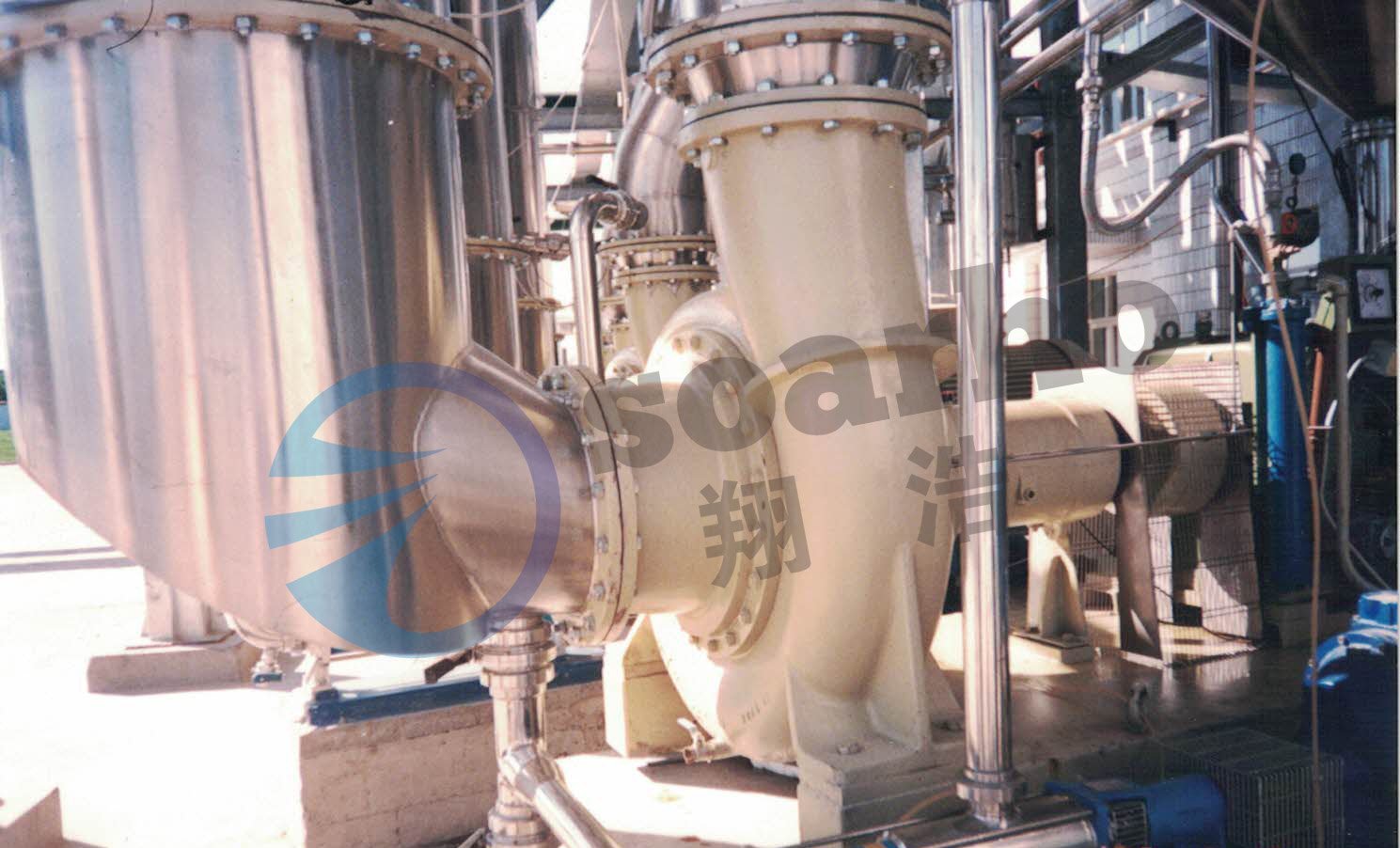
What kind of pump is a good pump? For the user of the pump, it is generally considered that the pump with high efficiency, low price and good effect is a good pump.
But in the practical application, only in the case of achieving the same useful effect, the lowest comprehensive use cost (including pump manufacturing cost, pump shutdown cost, operation cost, power consumption cost etc.) of the pump is a good pump.
An example is as follows:
The use of the first phase of A Power Plant and the second phase of the ash slag pump are as follows:
|
Engineering Staging |
Weight Concentration |
Pump Parameters |
Service Life of Wet Parts(month) |
|||
|
Cw(%) |
Outlet Diameter (mm) |
Flow(m3/h) |
Head(m) |
Pump Series |
||
|
Phase 1 |
5.7% |
250 |
1200 |
240 |
1 |
0.5 |
|
250 |
1200 |
120 |
2 |
2 |
||
|
Phase 2 |
14.3% |
200 |
650 |
57.5 |
4 |
18 |
According to the service life of the pump (parts) in the table above, the economic comparison is listed in the following table:
|
Engineering Staging |
Pump Series |
Pump |
Wet Parts |
Total Comprehensive Cost(¥) |
|
|
Purchase Price(¥) |
Annual Consumption(sets) |
Annual Total Costs(¥) |
|||
|
Phase 1 |
1 |
100,000 |
24 |
1,008,000 |
1,108,000 |
|
2 |
200,000 |
12 |
504,000 |
704,000 |
|
|
Phase 2 |
4 |
304,000 |
2.67 |
78,700 |
382,700 |
It can be viewed on the above two tables that the four-stage series pumps have the least annual spare parts (12/18 4=2.67 sets) and the maximum economic benefits in long-term operation. Due to the low speed and low head, the operating reliability is higher.
Depending on this idea, in view of the slurry pump design and use, combined with the use of experience, we suggest the following aspects.
1. Design parameters of slurry pump
1.1 Relationship between flow rate and the inlet and outlet of slurry pump
When the design flow Q is determined, the paramount consideration is the diameter of the outlet of the pump. It is recommended to determine the outlet diameter and inlet diameter of the pump:
Do≈6.1Q0.53 mm
Di=Do+Ck mm
Where: Q-Pump design flow, m3/h
Do-Pump outlet diameter, rounded to standard diameter after calculation
Ck -Experience constant, generally Ck=20~50 mm
1.2 Relationship between pump head and speed:
Hn/1000≤KHn
Where: H- Pump head, m
n - Pump speed, r/min
KHn- Empirical coefficient related to the service life of the pump, whose value is as follows:
|
Slurry Abrasion Characteristics |
Heavy Duty |
Moderate Duty |
Light Duty |
|
KHn |
20-60 |
60-90 |
90-120 |
2. Use the right pump material
In the use of the slurry pump, it is also important to correctly select the material of the wet parts suitable for the working condition. If the material of the wet parts is not properly selected, the pump service life will be greatly shortened.
At present, there are two kinds of materials commonly used in slurry pump wet parts: metal material and non-metal material.
2.1 Commonly used metal materials include KmTBCr26, KmTBCr15Mo3, etc. When solid particles are coarse, KmTBCr15Mo3 should be utilized, and KmTBCr26 should be used for fine particles.
2.2 Non-metallic materials:
2.2.1 Rubber materials: natural rubber, butyl rubber, etc., suitable for conveying round particles (such as river sand) and fine particles (d≤0.5mm) abrasive slurry.
2.2.2 Polyurethane material: the abrasion resistance is the same as the metal material, and it can be used as the part with weak bearing capacity. It is not a substitute for rubber.
2.2.3 Ceramic materials: suitable for slurry with corrosion, abrasion and low impact toughness.